How to Build a Sales Funnel for Coaches (Step-by-Step Guide)
Most coaches have amazing skills and get real results for clients — but they lose potential clients because there’s no clear path from “I found you online” to “I’m ready to pay you.” That path is your sales funnel. This guide breaks down exactly how to build a sales funnel for coaches that consistently converts strangers into paying clients — without paid ads or complicated tech.
What Is a Sales Funnel for Coaches?
A sales funnel is a system that guides a potential client through a deliberate journey — from first discovering you, to trusting you, to investing in your coaching offer. It’s called a funnel because many people enter at the top (awareness) and a smaller number come out the bottom as paying clients. That’s completely normal and expected.
Without a funnel, coaches rely on hope marketing: posting content and hoping someone reaches out. With a funnel, you have a predictable, repeatable system that works even when you’re not actively selling.
A sales funnel turns your expertise into a system. It works for you 24 hours a day — attracting, nurturing, and converting clients while you focus on coaching.
The 4 Stages of a Coaching Sales Funnel
Every coaching funnel — simple or complex — moves potential clients through four stages. Understanding these stages is what lets you create the right content and touchpoints at the right time.
How to Build Your Coaching Sales Funnel: 7 Steps
Define Your Ideal Client and Irresistible Offer
Before you build anything, you need to be crystal clear on two things: who you’re serving and what transformation you’re promising. A vague offer (“I help people live better”) won’t convert — a specific offer will.
Your ideal client has a specific problem, a specific goal, and is at a specific stage. The more precisely you can describe them, the more everything else in your funnel will resonate with the people who are actually ready to hire you.
Your Offer FormulaI help [specific person] achieve [specific result] in [specific timeframe] without [common obstacle]. Every piece of your funnel flows from this sentence.
Create a Lead Magnet That Solves One Urgent Problem
Your lead magnet is the entry point to your funnel. It’s a free, immediately valuable resource you offer in exchange for someone’s email address. The best lead magnets solve one very specific problem your ideal client has right now — not a general topic, not a 50-page guide on everything.
“5-Step Morning Routine for High-Performance Coaches” — quick win, immediately actionable
A 20-minute video training on one specific topic your client is already searching for
“What’s Your Coaching Bottleneck?” — high engagement and natural personalisation
A 3–5 day challenge delivering quick, visible progress — strong community and conversion potential
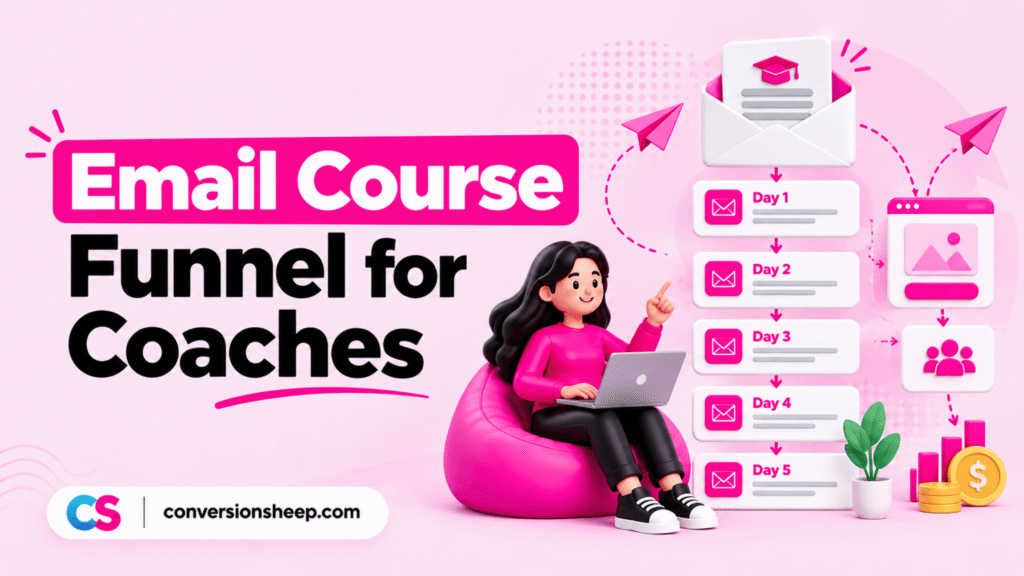
A 5-day email series that builds value daily and naturally leads to your paid offer
Works for high-ticket coaching — a 20-minute call that’s genuinely valuable and ends with an invitation
Build a High-Converting Landing Page
Your landing page has one job: convert visitors into email subscribers. No navigation menu. No distractions. One headline, one offer, one opt-in form. Everything on the page should serve that single purpose.
A strong landing page has five elements: a headline that names a specific outcome, a subheadline that adds credibility or urgency, three to five bullet points of what they’ll get, social proof (testimonials, number of subscribers, or a media mention), and a clear opt-in form with a benefit-driven button (“Send Me the Guide” beats “Submit”).
Page StructureHeadline → Subheadline → 3–5 benefit bullets → Opt-in form → Optional: testimonial or trust badges. That’s it. Simplicity converts better than complexity every single time.
Set Up Your Email Nurture Sequence
This is the most powerful part of your funnel — and the most overlooked. Once someone opts in, they’re interested but not ready. Your email sequence bridges the gap between curiosity and commitment by building trust over time, automatically.
A 5–7 email welcome sequence is the foundation. Each email has a purpose, delivered over 7–10 days after opt-in. Think of it as a conversation: you introduce yourself, tell your story, share value, address objections, and make an offer.
Deliver the lead magnet. Tell them who you are and what to expect from you.
Share your personal journey. Build connection through vulnerability and relatable experience.
Teach something genuinely useful. Show expertise without a pitch.
Share a client success story. Let results do the talking.
Address the #1 reason people hesitate. Reframe the obstacle.
Introduce your paid offer naturally. No pressure — just an invitation.
Remind them of the offer. Include a question that invites a reply.
Drive Targeted Traffic Into the Funnel
A perfect funnel with no traffic is a vending machine in an empty room. You need to consistently send the right people — your ideal clients — to your landing page. The good news: you don’t need ads to do this, especially in the early stages.
Post content that speaks to your ideal client’s pain points. Put your landing page link in bio.
Write articles targeting what your clients search for. Include opt-ins within the content.
Appear on podcasts your ideal clients listen to. Direct listeners to your lead magnet.
Tutorial-style videos rank on Google. Add your opt-in link in every video description.
Ask happy clients to share your lead magnet. Word-of-mouth brings your highest-quality leads.
Ideal for business or executive coaches. Long-form posts and direct outreach work well here.
Convert With a Discovery Call (or Sales Page)
For high-ticket coaching (programmes above £1,500–£2,000), the discovery call is your conversion point. For lower-priced offers like online courses or group programmes, a strong sales page handles the conversion without a call.
A great discovery call isn’t a sales pitch — it’s a structured conversation designed to help the prospect diagnose their problem and see the path to their goal. You ask, they talk. When the call is done well, the prospect sells themselves. You simply extend an invitation to work together.
Discovery Call StructureOpen with their situation → Explore the problem in depth → Uncover what it’s costing them → Paint the vision of their goal → Present your offer as the bridge → Handle objections calmly → Close with a clear next step.
Optimise Your Funnel With Data (Not Guesswork)
Once your funnel is live and getting traffic, optimisation is where you unlock real growth. Small improvements at each stage compound quickly — a 10% lift in landing page conversions and a 10% lift in email open rates can double your client numbers without generating any more traffic.
Track these four metrics every week: landing page conversion rate (aim for 25–40% for a lead magnet page), email open rate (aim for 30–45% with a warm list), click-through rate on your email CTA (aim for 3–8%), and discovery call booking rate from email (a benchmark: 1–3% of your list books a call per campaign).
What to Test FirstLanding page headline → Lead magnet topic → Email subject lines → CTA button copy. Test one element at a time. Give each test at least 100 visitors or 500 email sends before drawing a conclusion.
Frequently Asked Questions
- How long does it take to build a sales funnel for coaches?
A basic funnel — landing page, lead magnet, and a 5-email welcome sequence — can be built in a focused weekend. Getting it fully optimised and consistently converting takes 60–90 days of iteration. Most coaches overcomplicate it: start simple, then refine based on real data.
- Do I need to spend money on ads to make my funnel work?
No. Many coaches build highly profitable funnels entirely with organic traffic from social media, SEO content, and referrals. Ads amplify a funnel that’s already converting — they don’t fix one that isn’t. Get organic conversions first, then consider paid traffic to scale what’s working.
- What’s the best email platform for a coaching funnel?
ConvertKit (now Kit) is the most popular choice for coaches and creators — it’s built around sequences and tags, making segmentation straightforward. MailerLite is a strong free alternative. ActiveCampaign offers more advanced automation if you need it. Start with whichever has the lowest learning curve for you and switch when you outgrow it.
- How many emails should my nurture sequence have?
Five to seven emails over 7–10 days is the sweet spot for a welcome sequence. After that, shift to a regular broadcast schedule (weekly or bi-weekly). The sequence builds the relationship; ongoing broadcasts maintain it and surface new buyers when the timing is right for them.
- What conversion rate should I expect from my coaching funnel?
For a lead magnet landing page: 25–40% is healthy (meaning 1 in 4 visitors opts in). For email-to-discovery-call conversion: 1–3% per campaign is typical. For discovery call-to-client conversion: 50–70% is achievable with a qualified lead and a well-run call. These benchmarks improve significantly as you optimise each stage.
Your Coaching Funnel Launch Checklist
- Write your one-sentence offer using the formula: I help [person] get [result] in [time] without [obstacle]
- Create one specific lead magnet that solves an urgent, defined problem
- Build a distraction-free landing page with a single opt-in CTA
- Write and schedule a 5–7 email welcome sequence in your email platform
- Set up Calendly (or similar) for discovery call bookings with a pre-call form
- Choose one traffic channel and post consistently for 30 days before evaluating
- Track landing page conversion rate, email open rate, and CTR weekly
Want a Done-For-You Sales Funnel Built for Your Coaching Business?
Book a free strategy session and let’s map out a funnel tailored to your offer, your audience, and your goals — from lead magnet to discovery call system.
Book Your Free Growth Session →